
15 February 2026
There’s something about waking up at 4am for a road trip that feels like a quiet act of rebellion.
Rebellion against routine.
Against comfort.
Against the idea that adventure must be far away.
On this particular Sunday morning, we left Maseru at 6:30am, chasing the sunrise toward Ha Lejone — a small town about 15km from Katse Dam, tucked deep within Lesotho’s highlands.
Lesotho — the Mountain Kingdom, the Kingdom in the Sky — is often described as “a country no one has ever heard of.” For those of us born and raised here, that statement stings. But it also fuels something deeper: the responsibility to tell our own stories.
And as I often say — charity begins at home.
If we want the world to see Lesotho differently, we must first explore it ourselves.
The Drive: Mafika Lisiu Mountain Pass
To reach Ha Lejone, you must brace the legendary Mafika Lisiu Pass — a 26km climb rising up to 3,091 meters above sea level.
It is longer and steeper than Moteng Pass, and it demands respect.
This is not a drive for distraction.
Low gears. Slow movement. Full attention.
Originally built to allow heavy-duty trucks access to the Katse Dam construction site, the pass has since become one of Lesotho’s most scenic tourist routes. In winter, it transforms into a snow-dusted spectacle. In summer, it stretches endlessly into dramatic ridgelines that remind you how small — and how alive — you are.
Travel lesson: sometimes the journey is not a means to the destination. It is the destination.
The Experience: Life at 3,000 Meters
What makes Escapes meaningful is not just the views we photograph — it’s the lives we encounter.
On this trip, we spent time with two herd-boys who welcomed us into their motebo — a stone-and-thatch mountain hut that serves as both shelter and home.
Inside: firewood stacked neatly.
Outside: sheep grazing freely.
Above: endless sky.
One of the young men, 18 years old, left home to herd livestock. He has never visited Maseru or Hlotse. His diet consists mainly of maize meal, beans, and wild plants. He owns a small feature phone powered by a solar panel that lasts three to five days.
It struck me deeply.
How can two worlds exist within 90 kilometres of each other?
This is why storytelling matters. Because development conversations must include the lived realities of people in remote places. Tourism, when done ethically and intentionally, becomes more than sightseeing — it becomes economic inclusion.
The Viewpoint & Beyond
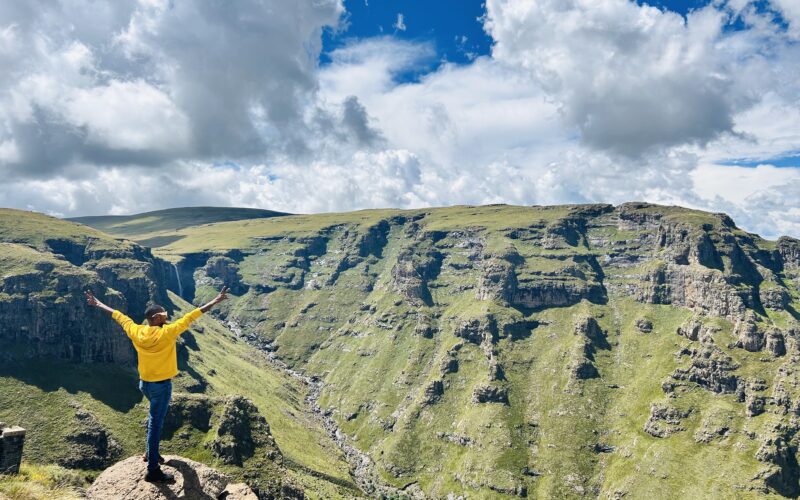
We stopped at the Mafika Lisiu Viewpoint, and even on my second visit, I was speechless.
The wind cuts through your jacket. The cold reminds you that you are high — very high. Pack properly. Gloves are not dramatic here; they are necessary.
A few kilometres away lies the breathtaking Bokong Nature Reserve, one of Lesotho’s hidden treasures. Vast landscapes. Untouched terrain. Silence that feels sacred.
This is the kind of place that resets you.
Lunch Stop: Motebong Lodge
We had lunch at Motebong Lodge, which offers accommodation, a restaurant, and boat cruises. Unfortunately, the cruise wasn’t operating that day — one of the realities of off-peak travel in smaller destinations.
And this is where finance meets travel.
Tourism sustainability requires consistent support. If we want better services, better infrastructure, and expanded offerings, we must travel locally — not only during holidays, but intentionally throughout the year.
Practical Travel & Budget Tips
Escapes are exciting — but intentional travel makes them sustainable.
Here’s how to plan your Ha Lejone trip wisely:
1. Leave Early
If driving from Maseru, depart by 6:30am at the latest. The round trip is long, and you’ll want time to explore without rushing.
2. Pack for Cold Weather
Weather changes rapidly in the highlands. Layer up.
3. Avoid Driving After 5pm
Mist rolls in quickly, reducing visibility. Engage low gears, avoid harsh braking, and drive steadily.
4. Budget Ahead
Decide what you want to spend before you leave. Fuel, food, and unexpected stops add up.
Carry cash — many remote areas still rely heavily on it, although mobile money is growing.
Travel does not have to be expensive. But it must be planned.
And that’s the heart of Escapes with TKay — showing that with financial intention, adventure becomes accessible.
Why We Must Tell Our Stories
Lesotho is not just mountains. It is resilience. Simplicity. Depth.
If we don’t document our journeys, someone else will — and they may not tell them with care.
When we travel locally:
- We support small lodges and local economies.
- We shift perception.
- We inspire the next Basotho child to see possibility beyond their immediate surroundings.
If you haven’t travelled through Lesotho’s highlands, I promise you — you have not fully experienced this country.
Plan the road trip.
Pack the jacket.
Set the budget.
Go.
You will return different.
Stay tuned for the vlog on YouTube.
Until then — stay trailblazing.
About Escapes with TKay
Escapes with TKay explores the intersection of finance, travel, and becoming — offering practical money insights, honest travel storytelling, and reflections on designing a life of intention, freedom, and sustainability.